
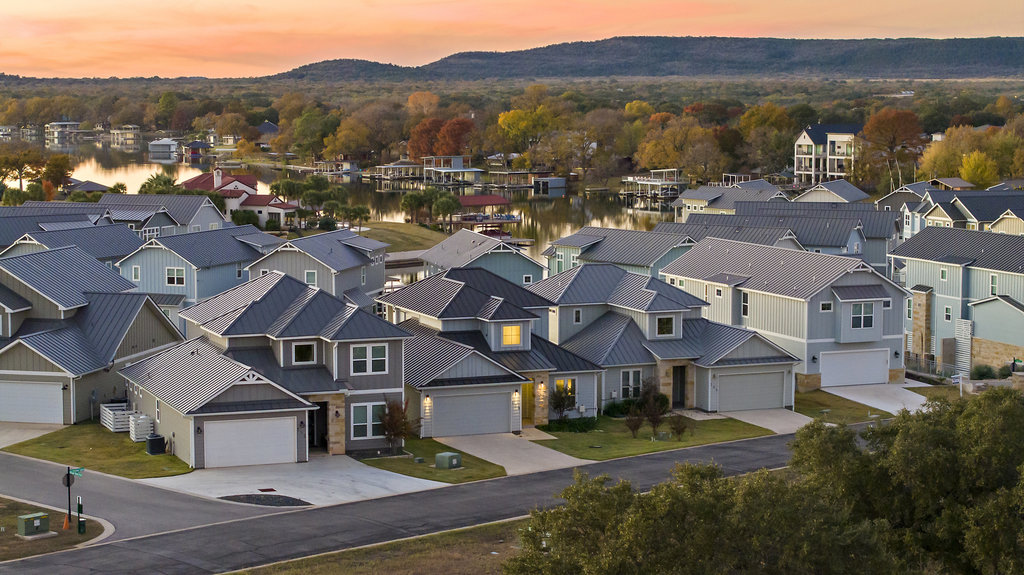
Short answer: In 2026, a fully custom, stick-built luxury home in the Texas Hill Country generally runs $250 to $400+ per square foot of conditioned living space — before land, and often before the site work that a rugged Hill Country lot demands. A well-appointed 3,500-square-foot home therefore lands somewhere between roughly $1.0M and $1.6M in construction cost, with true luxury finishes and difficult sites pushing higher.
That’s the number most buyers want up front. The rest of this guide explains what drives it, where the surprises hide, and how to build a budget that actually holds from contract to keys.
Why “price per square foot” only tells half the story
Price per square foot is the industry’s shorthand, and it’s useful for early planning. But two homes of identical size can differ by hundreds of thousands of dollars, because square-foot cost is really a summary of dozens of decisions: the complexity of the roofline, the ceiling heights, the window package, the level of millwork, and the site the home sits on.
In the Hill Country, the site is often the biggest swing factor. As a planning framework, here’s how finish level maps to cost in 2026:
| Finish level | Approx. cost / sq ft | What it typically includes |
|---|---|---|
| Entry custom | $200–$240 | Quality construction, mid-range selections, standard countertops and cabinetry |
| Mid-range custom | $240–$290 | Upgraded cabinetry, quartz/stone counters, hardwood or LVP, detailed trim, better windows |
| High-end luxury | $300–$400+ | Architectural rooflines, steel windows, imported stone, custom millwork, integrated smart home |
These ranges reflect conditioned living space. Covered patios, porches, and garages are usually priced separately at a lower rate, but they still add real dollars.
The Hill Country premium: site work and land conditions
This is where Hill Country budgets diverge from a flat suburban lot in the city. The same house costs more to build on a mesa above the Pedernales than on a graded pad in a production subdivision.
Rock excavation and site prep. Much of the Hill Country sits on limestone. Cutting a building pad, driveway, and utility trenches into rock can add $20,000 to $60,000 or more.
Wells and septic. Outside municipal service, you’ll need a private well and an aerobic septic system. Budget another $20,000 to $40,000+ combined.
Access, utilities, and slope. Long driveways, power to a remote homesite, retaining walls, and engineered foundations for expansive clay soils all add cost that never appears in a per-square-foot headline.
The takeaway: evaluate the lot before you fall in love with a floor plan. A good builder will walk a prospective lot with you and estimate site work before you close.
A realistic sample budget
Here’s how the pieces stack up for a mid-to-high-end 3,500-square-foot Hill Country home in 2026 — a planning illustration, not a quote.
| Cost component | Estimated range |
|---|---|
| Construction (3,500 sq ft @ $280–$340/sq ft) | $980,000 – $1,190,000 |
| Site prep / rock milling | $25,000 – $60,000 |
| Well + aerobic septic | $25,000 – $40,000 |
| Design & engineering fees | $40,000 – $90,000 |
| Landscaping, driveway, pool (optional) | $75,000 – $250,000+ |
| Land | Varies widely — often $200k to $1M+ |
Design fees, site work, and outdoor living are frequently excluded from a builder’s headline square-foot price. When you compare bids, confirm exactly what each number includes.
Fixed-cost, cost-plus, or hybrid — and why it changes your budget
A fixed-cost contract gives you a single guaranteed price and puts overage risk on the builder. A cost-plus contract passes actual costs through with a builder’s fee — more transparency, less certainty. A hybrid blends the two. We break these down in our guide to custom home building contracts. The more finalized your plans and selections are before you sign, the more accurate any contract’s number will be.
Where budgets actually go over — and how to prevent it
Allowances set too low. Insist on allowances that reflect the finishes you actually want, not placeholder numbers.
Change orders. Finalizing selections before construction starts is the most effective way to protect your budget.
Underestimating the site. The number-one Hill Country budget-buster.
Skipping a contingency. Carry a 5–10% contingency on top of the contract.
How to build a budget that holds
- Get the lot evaluated first. Site conditions drive more variance than any finish decision.
- Define your finish level honestly. Don’t budget entry-custom and select full luxury.
- Ask what’s included. Compare bids apples-to-apples — design fees, site work, outdoor living, allowances all in.
- Finalize plans and selections before you sign.
- Carry a contingency. 5–10%. Every time.
Frequently asked questions
What is the average cost per square foot to build a custom home in the Texas Hill Country in 2026?
Most fully custom homes fall between $250 and $400+ per square foot of conditioned space, with mid-range luxury commonly landing around $280–$340.
Does that price include the land?
No. Per-square-foot construction pricing excludes land, site work (rock, well, septic), design fees, and outdoor living.
Why is building in the Hill Country more expensive than in the city?
Limestone excavation, private wells and septic, steep or remote sites, long utility runs, and engineered foundations all add cost.
How much contingency should I budget?
Plan for 5–10% above your contract price; lean toward 10% on difficult lots or highly customized designs.
How long does a custom home take to build here?
Most luxury Hill Country builds run roughly 12–18 months once construction starts. See how long it takes to build a custom home.
Thinking about building in the Highland Lakes, Horseshoe Bay, or greater Hill Country? Request a free consultation with Goliath Luxury Homes and we’ll walk your lot and give you a realistic budget before you commit.